Let’s start with wikipedia’s common, boring definition:
“Kitsch is a term of German or Yiddish origin that has been used to categorize art that is considered an inferior, tasteless copy of an existing style. The term is also used more loosely in referring to any art that is pretentious to the point of being in bad taste, and also commercially produced items that are considered trite or crass.”
And now some items: kitsch or. . . cool?
Elvis and Jesus
Unicorn and princess
A Skull by D. H.
Big pink clock
Glow in the dark Jesus
And more religious objects
So, where is the line? And If we’re laughing but the people who created it aren’t, who’s the elitist, racist, etc?
And one last seasonal object
Ok, and further into wikipedia one reads:Further into the wikipedia article one reads: “the word was brought into use as a response to a large amount of art in the 19th century where the aesthetic of art work was associated with a sense of exaggerated sentimentality or melodrama, kitsch is most closely associated with art that is sentimental [--] It is often said that kitsch relies on merely repeating convention and formula, lacking the sense of creativity and originality displayed in genuine art.”
And that brings us to:
Thomas Kinkade, Painter of Light
And, specifically:
His Jesus
His “Pools of Serenity”
And one more
But, there are also the people that make fun of Kinkade:
Car Crash Kinkade
Cicada (?) Kinkade
Milan Kundera “The Unbearable Lightness of Being” there’s a brief passage where he discusses kitsch.
Kundera’s character is a response, partially, to kitsch as a “word that was popularized in the 1930s by the theorists Theodor Adorno, Hermann Broch, and Clement Greenberg, who each sought to define avant-garde and kitsch as opposites. To the art world of the time, the immense popularity of kitsch was perceived as a threat to culture. The arguments of all three theorists relied on an implicit definition of kitsch as a type of false consciousness, a Marxist term meaning a mindset present within the structures of capitalism that is misguided as to its own desires and wants. Marxists suppose there to be a disjunction between the real state of affairs and the way that they phenomenally appear.”
Kundera is responding to the Soviety “art” that lacks substance. The parade that’s repeated in The Joke at the end is an example of kitsch.
Perhaps some photographs could help here in trying to understand the differences between kitsch and the avant-garde.
So, lets start with Anne Geddes:
“Born and raised in Queensland, Australia, Anne Geddes has always been interested in the strength that a photographic image could hold. In her mid-twenties, she began experimenting with the family camera, developing her signature style of simple structure and immediate visual impact.”
And a bit further down on that same page:
“One of the world's most respected and successful professional photographers, Anne has captured the imagination and hearts of people around the globe. Her distinctive, award-winning images of children have become classic icons celebrating life and birth. They grace greeting cards, calendars, books, stationery, photo albums, and an array of other fine products, and are currently published in over 50 countries. ”
This is Anne Geddes official website
Just a Baby!
Mother and Daughter
And Anne Geddes using pastels
The Onion’s jab at Anne Geddes , because I couldn’t resist
and one more
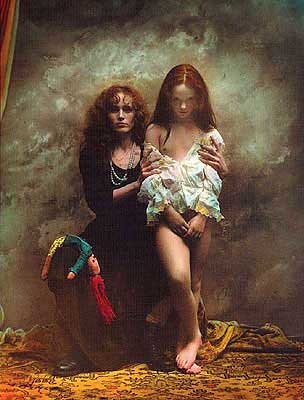
And now Jan Saudek, who was born in Prague in 1935, is contemporaneous with Milan Kundera, and, like Geddes, often takes as his subjects women and children.
His and his wife, Sara’s, website can be Jan Saudek WebSite
Jan Saudek
One Image
an other example
and one more
They both take as their subject family and use rather outlandish, excessive colors-- sometimes painted onto black and white prints. . . so what’s the difference between Anne Geddes and Jan Saudek?
And with movies? Where’s the line between the “avant-garde,” kitsch, and camp?
Let’s start with Jim Sharman’s “Rocky Horror Picture Show” (1975).
I pulled this description from a movie rental review site: “ROCKY HORROR opens with conservative young couple (Barry Bostwick and Susan Sarandon), experiencing a flat tire on a rainy night. They are near a menacing-looking Ohio castle and stumble upon what they think are their saviors. Brad and Janet's normality is no match for Dr. Frank N. Further, the cross-dressing, mad scientist leader of this convention of deviancy (played unforgettably by Tim Curry).
The film follows Brad and Janet's descent into the world of Dr. Frank N. Further and his minions. He is building what he terms a perfect love god, in the form of a muscle bound blond named "Rocky." As Brad and Janet rediscover their own sexualities and Rocky desperately wants to discover his own, the film grows more surreal, ending in the massive revelation that Dr. Frank N. Furter's glammed out, androgynous self is more than just different, it is out of this world. However, the hunchback Riffraff (director Richard O'Brien, who also wrote the musical score) deems the Doctor's lifestyle "too extreme" and subtly takes over in a very obvious reference to the powers of conformity quashing the wildly different when it gets in the way of the greater plan.”
And then there’s also this comment:
“The definition of kitsch, THE ROCKY HORROR PICTURE SHOW is a campy, musical spoof on the haunted-castle horror movie, encompassing a 70's glam-rock world of androgyny with characters that are more than offbeat. Adults have been gathering at ritualistic midnight viewings of Rocky Horror across the country since its 1975 debut, contributing to its cult classic title.”
You Tube Rocky Horror You Tube Clips
Intro w/ credits:
First Scene:
]
First Song, Damn It, Janet! I Love You (Let’s Go Screw):
[]
Broke Down in the Rain:
[
Time Warp:
And Sweet Transvestive:
And towards the end, things look like this before they’re wisked away on the space ship:
So is it kitsch. . .? Or camp? or something else. . . ?
And this where we move towards discussing the difference between kitsch and camp. Both are excessive and involve exaggerations, but kitsch takes itself seriously and isn’t serious, where as camp doesn’t take itself seriously and is serious. . .
Some key points to take away from Susan Sontag’s “Notes on Camp”
She begins, “A sensibility (as distinct from an idea) is one of the hardest things to talk about; but there are special reasons why Camp, in particular, has never been discussed. It is not a natural mode of sensibility, if there be any such. Indeed the essence of Camp is its love of the unnatural: of artifice and exaggeration. And Camp is esoteric -- something of a private code, a badge of identity even, among small urban cliques. ”
Her Point: “1. To start very generally: Camp is a certain mode of aestheticism. It is one way of seeing the world as an aesthetic phenomenon. That way, the way of Camp, is not in terms of beauty, but in terms of the degree of artifice, of stylization.”
And then notes: “2. To emphasize style is to slight content, or to introduce an attitude which is neutral with respect to content. It goes without saying that the Camp sensibility is disengaged, depoliticized -- or at least apolitical. ”
So, not political. But what about the religious objects?
An example Sontag cites of kitsch: The Enquirer Headlines and Stories
An other important point: “5. Camp taste has an affinity for certain arts rather than others. Clothes, furniture, all the elements of visual décor, for instance, make up a large part of Camp. For Camp art is often decorative art, emphasizing texture, sensuous surface, and style at the expense of content. ”
And why Art Nouveau is camp: “8. Camp is a vision of the world in terms of style -- but a particular kind of style. It is the love of the exaggerated, the "off," of things-being-what-they-are-not. The best example is in Art Nouveau, the most typical and fully developed Camp style. Art Nouveau objects, typically, convert one thing into something else: the lighting fixtures in the form of flowering plants, the living room which is really a grotto. A remarkable example: the Paris Métro entrances designed by Hector Guimard in the late 1890s in the shape of cast-iron orchid stalks.”
Has everyone seen that Metra sign down the street? With the red-lights and green, cast iron stalks?
And it’s this point that especially helps one to starts distinquishing kitsch from camp: “18. One must distinguish between naïve and deliberate Camp. Pure Camp is always naive. Camp which knows itself to be Camp ("camping") is usually less satisfying.”
So: “24. When something is just bad (rather than Camp), it's often because it is too mediocre in its ambition. The artist hasn't attempted to do anything really outlandish. ("It's too much," "It's too fantastic," "It's not to be believed," are standard phrases of Camp enthusiasm.)”
Sontage on camp and film, “29. The reason a movie like On the Beach, books like Winesburg, Ohio and For Whom the Bell Tolls are bad to the point of being laughable, but not bad to the point of being enjoyable, is that they are too dogged and pretentious. They lack fantasy. There is Camp in such bad movies as The Prodigal and Samson and Delilah, the series of Italian color spectacles featuring the super-hero Maciste, numerous Japanese science fiction films (Rodan, The Mysterians, The H-Man) because, in their relative unpretentiousness and vulgarity, they are more extreme and irresponsible in their fantasy - and therefore touching and quite enjoyable.”
And: “41. The whole point of Camp is to dethrone the serious. Camp is playful, anti-serious. More precisely, Camp involves a new, more complex relation to "the serious." One can be serious about the frivolous, frivolous about the serious.”
And last but not least: “58. The ultimate Camp statement: it's good because it's awful . . . Of course, one can't always say that.”
From Susan Sontag’s "Notes on Camp." Agree, disagree? Examples?
Guy Maddin has directed a number of films The Saddest Music in the World, Brand Upon the Brain! (2006), and many and others. Many of his films are black and white with musical numbers that use turn to the century editing techniques. But they have more contemporary themes and interests:
I wanted to show Brand Upon the Brain, but the library couldn’t get it:
So, here’s a clip with some commentary
It’s interesting to note his reliance on old film and staging techinqiues and Sontag’s point that: “31. This is why so many of the objects prized by Camp taste are old-fashioned, out-of-date, démodé. It's not a love of the old as such. It's simply that the process of aging or deterioration provides the necessary detachment -- or arouses a necessary sympathy. When the theme is important, and contemporary, the failure of a work of art may make us indignant. Time can change that. Time liberates the work of art from moral relevance, delivering it over to the Camp sensibility. . . . ”
And here’s a short he directed that’s a bit more “obviously” campy.
"Sissy Boy Slap Party Director's Cut" (2004)
And then there’s also:
“But I’m a Cheerleader!” (1999) trailer:
And Steven Shainberg's "Secretary" (2002) trailer
And now John Waters
Monday, November 19, 2007

Monday, November 5, 2007
Caricature, Cartoons, Comics, Comedy?
English Caricature:
"The arc of popularity for satirical prints in England began in the early 1700s, peaked in the 1790s, and declined in the early 1800s. During this time, thousands of prints were published in England. They were produced in editions of hundreds and sometimes thousands of copies. Today, the British Museum preserves 10,000 of these prints. Several thousand more in the U.S Library of Congress and other museums.
In the late-1700s, London printshops and booksellers displayed prints in their storefront windows. Crowds of customers, along with people who couldn't afford prints, crowded the sidewalks to see new works by William Hogarth, Isaac Cruikshank and others.
During this time, the term caricatura came into use in England as caricature. The printshops used the term to define a genre that included virtually any print with a satirical or humorous theme."
And, further from English Caricatures
"Today, these prints exist as one of the only visual forms to document the historical events of the day, the moods of the public, and the fashions of clothing. This era came to be known as the golden age of the English engraver."
See, for exaple: James Gillray's MONSTROUS CRAWS, at a New Coalition Feast
Or, for fashion, James Gillray's The V_____ Committe framing a Report
Or fungi, James Gillray's An Excrescence; __ a Fungus;
Now, French Caricature History:
“French political caricatures of the 19th century chronicle the gradual,
often-violent end of the Monarchy and the emergence of a democratic state. French rulers strictly regulated the popular press, especially satirical images. In a time when a large percentage of the population couldn't read, these images were seen as a greater threat to the established order than the printed word.
French caricaturists worked under government-imposed censorship throughout most of the 19th century. Artists and editors were imprisoned, fines were levied and newspapers were seized. Offenders were rigorously prosecuted for "press crimes," which authorities interpreted as alleged defamatory and subversive attacks on the government."
And, further:
“During the 1700's, the art of engraving was unrestricted but the sale of prints was subject to censorship through the lieutenant general of the police. Offenders could pay with their lives. One caricaturist was burned alive for portraying Louis XIV with his mistresses." Althought, apparently in England Gillray could get away with showing someone seeking "petticoat influence," QUESTION & COMMANDS; OR, the Road to HE_R_FORD; a Sunday Evenings Amusement
And, a bit further,
"Censors prevented the distribution of prints that were considered harmful to "religion, the general good and the peace of the State, and the purity of morals." Political prints from England were also seen as a threat and attempts were made to stop them before they entered France. But this ban on imported prints had limited effect and a large black market developed for English engravings."
All via, French Caricatures
For an example of Gillray on the French political situation, Gillray’s Destruction of the French Collossus
Later, "In the 1860s and 1870s, André Gill was the unchallenged master of caricature in France. Gill drew full-page colored illustrations of famous personalities that were published on the covers of large-format caricature journals. When displayed on newsstands, they functioned as political posters. His work for La Lune generated a circulation of 40,000 copies."
Examples, Gill’s L’Ecclise
Other caricaturists of note, Honoré Daumier's Le Charivari, Alfred Le Petit's
Le Grelot, and an example of Gill's modified and unmodified versions of Gill’s La Deliverance
Today, we have several types of caricature in America.
Political caricature: Andy And Davey Politicans and Royalty
And celebrity caricature: Gallery of the Absurd
And political or lifestyle caricatures-cartoons, New Yorker Cartoons
Most comics use caricature and can be single panels or a series of sequential panels.
Single examples, Khalid Shaikh Mohammad Cartoons
Sequential examples, Doonsburry Daily Dose http://www.paulgravett.com/articles/051_planb/maus_extract.jpg
There are also more elaborate, political graphic novels that are at times humerous and sometimes use caricature, sure as Art Spieglman's Maus Maus Panel
Then, of course, there are moving cartoons.
For example, old Disney cartoons via You tube that aren't so comic now but do use caricature:
and, not so terrible:
There are also caricatures that poke fun of caricatures, such as this Cox + Combs George Washington You Tube Vid:
Also, their are caricatures of forms, or types, of representation. So, for example, Kevin Kalliher's Home Honey, I'm High!, which can be seen here: Home Honey, I’m High
Then there are more normal forms of animation that use caricature, such as The Simpsons and Family Guy:
And then, thing, well, some other types of life-style documentation that may or may not fall somewhere else. . .
Zombie Yoga
And, last: American Furry: Life, Liberty, and the Fursuit of Happiness
Any questions?
"The arc of popularity for satirical prints in England began in the early 1700s, peaked in the 1790s, and declined in the early 1800s. During this time, thousands of prints were published in England. They were produced in editions of hundreds and sometimes thousands of copies. Today, the British Museum preserves 10,000 of these prints. Several thousand more in the U.S Library of Congress and other museums.
In the late-1700s, London printshops and booksellers displayed prints in their storefront windows. Crowds of customers, along with people who couldn't afford prints, crowded the sidewalks to see new works by William Hogarth, Isaac Cruikshank and others.
During this time, the term caricatura came into use in England as caricature. The printshops used the term to define a genre that included virtually any print with a satirical or humorous theme."
And, further from English Caricatures
"Today, these prints exist as one of the only visual forms to document the historical events of the day, the moods of the public, and the fashions of clothing. This era came to be known as the golden age of the English engraver."
See, for exaple: James Gillray's MONSTROUS CRAWS, at a New Coalition Feast
Or, for fashion, James Gillray's The V_____ Committe framing a Report
Or fungi, James Gillray's An Excrescence; __ a Fungus;
Now, French Caricature History:
“French political caricatures of the 19th century chronicle the gradual,
often-violent end of the Monarchy and the emergence of a democratic state. French rulers strictly regulated the popular press, especially satirical images. In a time when a large percentage of the population couldn't read, these images were seen as a greater threat to the established order than the printed word.
French caricaturists worked under government-imposed censorship throughout most of the 19th century. Artists and editors were imprisoned, fines were levied and newspapers were seized. Offenders were rigorously prosecuted for "press crimes," which authorities interpreted as alleged defamatory and subversive attacks on the government."
And, further:
“During the 1700's, the art of engraving was unrestricted but the sale of prints was subject to censorship through the lieutenant general of the police. Offenders could pay with their lives. One caricaturist was burned alive for portraying Louis XIV with his mistresses." Althought, apparently in England Gillray could get away with showing someone seeking "petticoat influence," QUESTION & COMMANDS; OR, the Road to HE_R_FORD; a Sunday Evenings Amusement
And, a bit further,
"Censors prevented the distribution of prints that were considered harmful to "religion, the general good and the peace of the State, and the purity of morals." Political prints from England were also seen as a threat and attempts were made to stop them before they entered France. But this ban on imported prints had limited effect and a large black market developed for English engravings."
All via, French Caricatures
For an example of Gillray on the French political situation, Gillray’s Destruction of the French Collossus
Later, "In the 1860s and 1870s, André Gill was the unchallenged master of caricature in France. Gill drew full-page colored illustrations of famous personalities that were published on the covers of large-format caricature journals. When displayed on newsstands, they functioned as political posters. His work for La Lune generated a circulation of 40,000 copies."
Examples, Gill’s L’Ecclise
Other caricaturists of note, Honoré Daumier's Le Charivari, Alfred Le Petit's
Le Grelot, and an example of Gill's modified and unmodified versions of Gill’s La Deliverance
Today, we have several types of caricature in America.
Political caricature: Andy And Davey Politicans and Royalty
And celebrity caricature: Gallery of the Absurd
And political or lifestyle caricatures-cartoons, New Yorker Cartoons
Most comics use caricature and can be single panels or a series of sequential panels.
Single examples, Khalid Shaikh Mohammad Cartoons
Sequential examples, Doonsburry Daily Dose http://www.paulgravett.com/articles/051_planb/maus_extract.jpg
There are also more elaborate, political graphic novels that are at times humerous and sometimes use caricature, sure as Art Spieglman's Maus Maus Panel
Then, of course, there are moving cartoons.
For example, old Disney cartoons via You tube that aren't so comic now but do use caricature:
and, not so terrible:
There are also caricatures that poke fun of caricatures, such as this Cox + Combs George Washington You Tube Vid:
Also, their are caricatures of forms, or types, of representation. So, for example, Kevin Kalliher's Home Honey, I'm High!, which can be seen here: Home Honey, I’m High
Then there are more normal forms of animation that use caricature, such as The Simpsons and Family Guy:
And then, thing, well, some other types of life-style documentation that may or may not fall somewhere else. . .
Zombie Yoga
And, last: American Furry: Life, Liberty, and the Fursuit of Happiness
Any questions?
Subscribe to:
Comments (Atom)